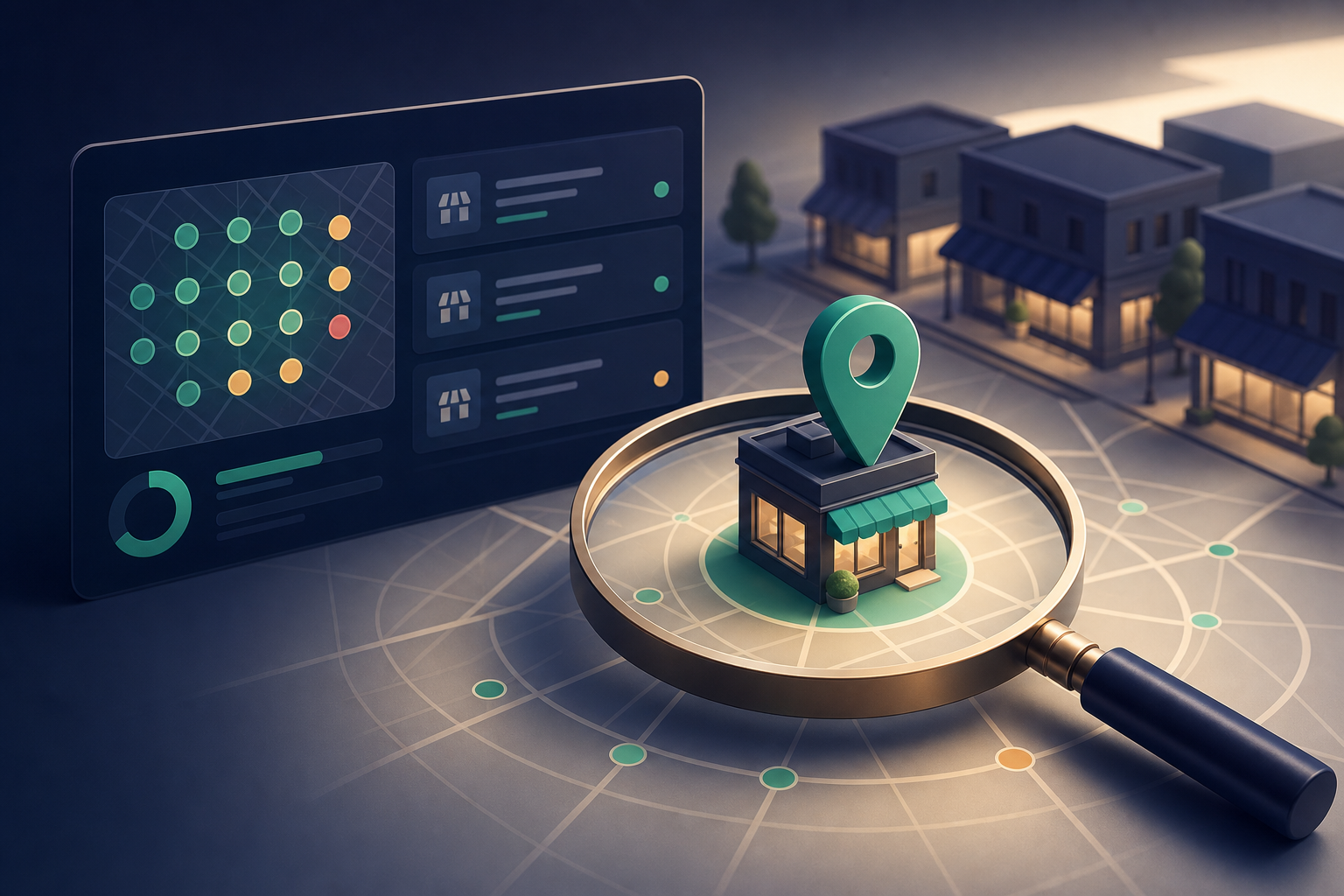
A local rank tracker shows where your business appears in Google Maps and local search for a keyword, plus where it appears around your service area. That matters because local rankings are not one-size-fits-all: a customer searching across town may see different results than someone standing near your storefront. If you want better local SEO decisions, track neighborhood-level visibility, map pack positions, and the business profile signals that help explain movement.
Quick answer: what a local rank tracker should tell you
At minimum, a local rank tracker should answer three questions:
- Where do you rank for your most important keywords?
- How do rankings change by location or neighborhood?
- Are changes tied to your Google Business Profile, reviews, or website updates?
If a tool only gives you a single citywide position, it may miss the most important reality of local search: Google Maps results are location-sensitive. For many businesses, the real question is not “Do we rank?” but “Where do we rank, and for whom?”
Why local rankings are different from organic rankings
Local SEO has two layers of visibility. One is standard organic search results. The other is local results in Google Maps and the map pack. A business can do well on its website and still underperform in Maps, or the reverse.
That is why local rank tracking is useful. It helps you separate site performance from profile performance. It also helps you spot whether your business shows up for searches that match your actual services, instead of only for broad terms.
If your main goal is to understand how to rank in the map pack, start with HOW TO Rank IN Google MAP Pack. A local rank tracker is the measurement side of that work: it shows whether your actions are moving visibility in the right places.
What a good local rank tracker measures
A useful local rank tracker should measure more than a single ranking number. Look for these core signals:
1. Keyword-level visibility
Track the search terms people actually use to find your business. For example, a plumber might track "emergency plumber," "water heater repair," and "drain cleaning." A dentist might track "cosmetic dentist," "teeth whitening," and "family dentist."
The point is to measure the keywords that matter to your real demand, not just vanity terms.
2. Neighborhood or grid rankings
Local results vary from one area to another. A map-grid view shows how visibility changes across multiple points in the same city or service area. This is often the most helpful part of a Measure Improve workflow because it makes local competition visible in a practical way.
Instead of asking whether you rank at all, grid data answers:
- Which neighborhoods see you consistently?
- Where do you fall out of the top results?
- Are you strong near your location but weak farther out?
3. Google Maps and map pack visibility
For many local businesses, the most valuable clicks come from Maps and the map pack, not from broad web search. Track whether your business appears in those surface areas, especially for your highest-intent queries.
4. Trend changes over time
One ranking snapshot is not enough. You want to see whether visibility improves, slips, or stays flat after specific changes, such as:
- updating the Google Business Profile
- adding new service or location content to the website
- earning more reviews
- fixing inconsistent business information
How to read local rank tracker data without overreacting
Local rank data can look noisy if you expect it to behave like a traditional SEO report. Small shifts are normal. A business may move up in one area and down in another on the same day.
Here is the most useful way to read the data:
- Look for patterns, not single-day spikes.
- Compare the same keyword across the same locations.
- Focus on meaningful movement in the areas where customers are most likely to search.
- Use trends to guide action, not to panic.
If rankings improved after a profile update, that is useful. If they improved in one neighborhood but not another, that is even more useful. It tells you where to focus next.
Common mistakes business owners make with local rank trackers
A local rank tracker is only helpful if you use it correctly. Common mistakes include:
Tracking too many keywords
It is better to track a small set of high-value keywords than hundreds of random phrases. Too many terms make it harder to see what matters.
Ignoring location context
A citywide average can hide weak performance in the neighborhoods that matter most. Local businesses should care about service areas, not just generic market-level numbers.
Treating rankings as the only goal
Rankings are a signal, not the goal. The real goal is visibility that leads to qualified traffic, calls, directions, and other actions from the right customers.
Not connecting rankings to profile health
Rank changes often make more sense when you also check reviews, categories, photos, service details, and consistency across your online presence.
How Aaptly helps
Aaptly helps local businesses measure and improve the signals that influence local visibility. In practice, that means you can connect rank tracking with the work that drives it:
- review and reputation trends
- Google Business Profile quality and completeness
- local visibility by area and keyword
- missed-lead and opportunity spotting
That matters because rank tracking is most useful when it leads to action. If you can see where visibility is weak, you can decide whether the issue is profile setup, content coverage, or local trust signals.
If you want a broader measurement workflow, Measure Improve is the place to start. And if your main issue is Google Maps visibility, the practical next step is to review HOW TO Rank IN Google MAP Pack.
What to do after you spot a ranking gap
When a local rank tracker shows weak performance, use it to choose the next fix:
- If rankings are weak across most areas, review the core Google Business Profile setup.
- If rankings are strong near your business but weak farther away, look at service area coverage and local relevance.
- If you rank for some services but not others, tighten your keyword-to-service alignment.
- If competitors outrank you in the same zone, compare their profile completeness, review momentum, and category fit.
This kind of reading turns rank tracking into a decision tool. Without that step, it is just a report.
Answer block: what local rank tracking is really for
A local rank tracker is not just a scorecard. It is a way to see how your business performs across the places and searches that matter most. The best use of it is to connect visibility trends with specific actions so you can improve local search results in the right neighborhoods and for the right keywords.
How to set up a simple tracking routine
You do not need a complex setup to get value from local rank tracking. Start simple:
- Choose 5 to 10 priority keywords.
- Define the neighborhoods or zones you care about.
- Check rankings on a regular schedule.
- Pair the data with profile updates, review changes, and website changes.
- Review trends monthly to decide what to improve next.
This is enough to make better local SEO decisions without getting buried in data.
Related resources
FAQ
What is the difference between a local rank tracker and a normal SEO rank tracker?
A normal SEO rank tracker usually focuses on website rankings in organic search. A local rank tracker focuses on Google Maps, map pack visibility, and how rankings change across different locations.
Do local rank trackers work for service-area businesses?
Yes. Service-area businesses benefit from grid-style tracking because it shows visibility across the areas they serve, not just near a storefront.
Should I track branded and non-branded keywords?
Yes, but non-branded keywords usually matter more for growth. Branded terms tell you whether people already know your business, while non-branded terms show how visible you are to new customers.
How do reviews affect local rankings?
Reviews can support local visibility by improving trust and freshness signals, especially when the review profile looks active and relevant to the services you provide.
What is the most important metric in local rank tracking?
There is no single metric that fits every business. For most local businesses, the most useful metric is visibility by location for the keywords that drive real leads.
Can I use local rank tracking to compare against competitors?
Yes. Competitive comparison helps you see where rivals are stronger, but the most useful insight is often where you are losing visibility in specific neighborhoods or service areas.